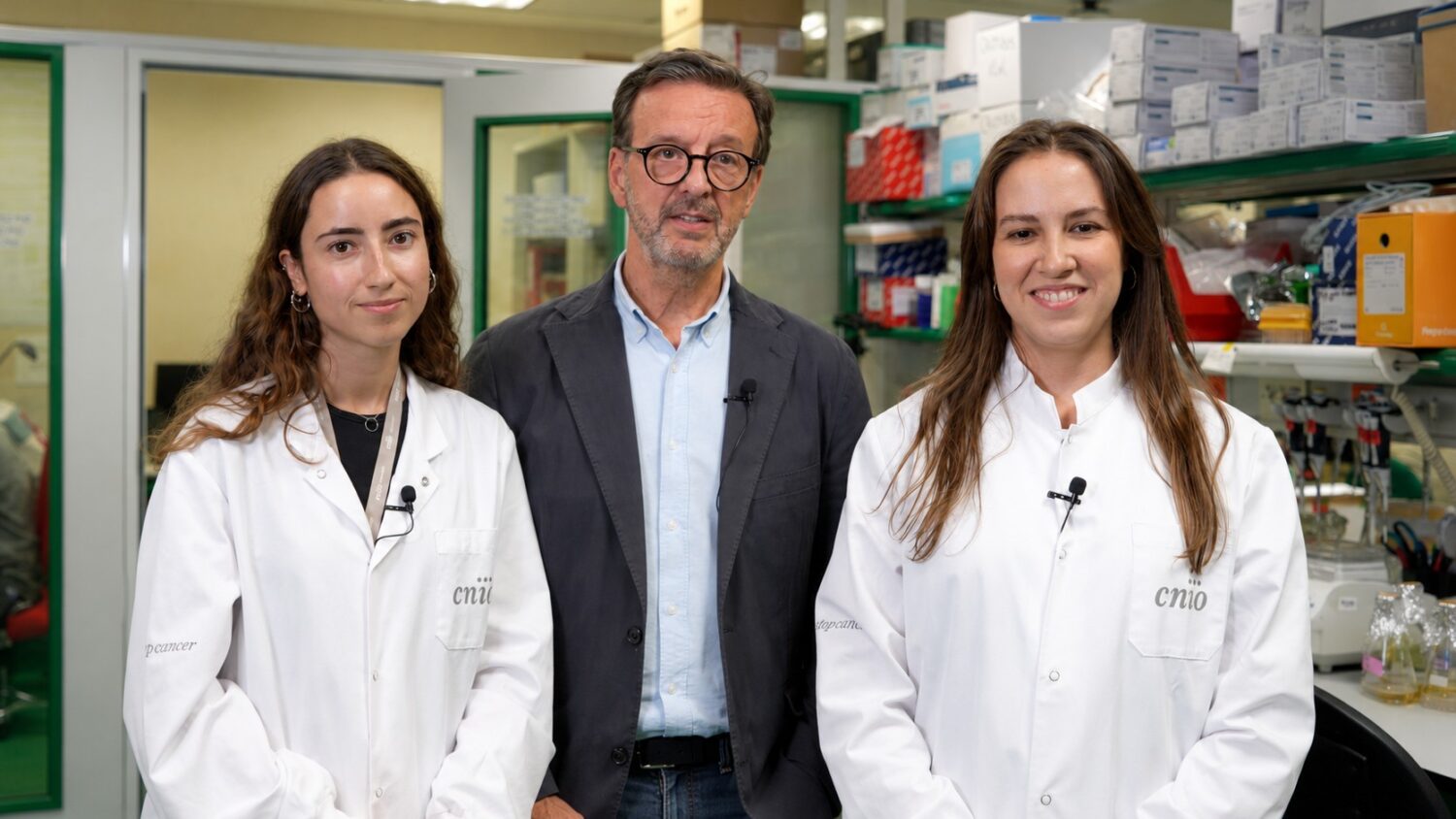
 From left: Susana Luengo-Arias, Luis Álvarez-Vallina and Anaïs Jiménez-Reinoso, researchers at the Spanish National Cancer Research Centre (CNIO), the Hospital del Mar Research Institute (HMRIB) and the Hospital 12 de Octubre Research Institute (i+12). / MadMoviex.CNIO
This new cell-based immunotherapy strategy has been demonstrated in mice.
It was developed by the Cancer Immunotherapy Research Group, a joint group of the Hospital del Mar Research Institute (HMRIB), the Spanish National Cancer Research Centre (CNIO) and the Hospital 12 de Octubre Research Institute (i+12).
The team can activate and regulate the antitumour activity of the cell therapy by administering a drug that acts as a chemical switch for the treatment.
The system has shown efficacy against both haematological malignancies and solid tumours in animal models. The ultimate aim is to prevent the toxic effects of cell therapies, particularly in solid tumours.
Treating cancer more effectively and with fewer side effects requires tailoring therapies to the unique characteristics of each patient. Cell therapies represent the highest degree of personalisation available today because they are produced by the patient’s own body: they involve modifying immune cells, known as T lymphocytes or T cells, taken from the patient to enhance their ability to detect and destroy tumour cells.
Cell therapies are already used in clinical practice for some blood cancers, but their use is still limited to a small number of cancer types. Intensive research efforts are under way to expand the range of tumours they can treat and, crucially, to reduce their side effects.
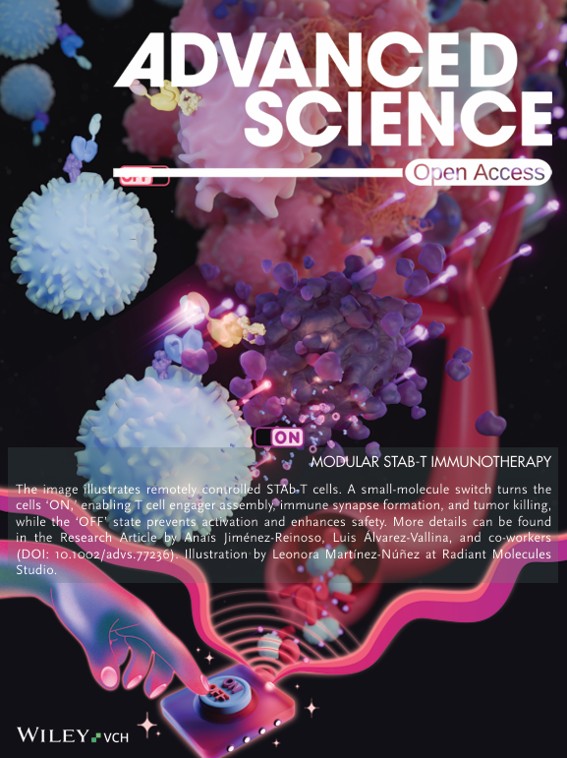
This is the aim of the new strategy developed by Luis Álvarez-Vallina’s team at the Spanish National Cancer Research Centre (CNIO), the Hospital del Mar Research Institute (HMRIB) and the Hospital 12 de Octubre Research Institute (i+12). It is featured on the cover of the latest issue of Advanced Science.
The team has developed a way to regulate the activity of STAb-T cell therapy using a drug that can be administered or withheld. In practice, the drug acts as a chemical switch that turns the cell therapy off or on, controlling the intensity of treatment with the aim of preventing excessive toxicity.
The strategy has been tested in animal models of several cancer types, including solid tumours. The team has demonstrated that the drug activates the modified T cells and also regulates their activity by adjusting the dose administered.
This is the first time this effect has been achieved in STAb-T therapies, a type of next-generation cell therapy developed by Álvarez-Vallina’s team that is currently undergoing clinical testing.
STAb-T cell therapy strengthens the body’s defences against cancer
In STAb-T therapy the patient’s T cells are modified in the laboratory to enhance their ability to recognise and destroy cancer, then reinfused into the patient. The distinguishing feature of this therapy is that the modified T cells secrete a type of antibody known as a bispecific antibody, which activates the patient’s immune system.
“In STAb-T immunotherapy, the modified T cells produce bispecific antibodies that form bridges between T cells and tumour cells. These bridges further enhance the ability of T cells to identify and destroy tumour cells,” explains Álvarez-Vallina.
In the study now published in Advanced Science, co-led by Álvarez-Vallina and Anaïs Jiménez-Reinoso, the team engineered the modified T cells to produce the components of the bispecific antibodies separately, “and the active bispecific antibody is only assembled when the patient receives the drug,” adds Álvarez-Vallina. “This allows us to switch the system off or on, and even regulate its potency and how long it remains active.”
Activity against solid tumours
As Susana Luengo-Arias, first author of the study, explains, “the drug acts as a chemical switch. The modified T cells only activate and assemble the two antibody modules in the presence of the drug, triggering the immune response against the tumour.”
“This ability to regulate activity is particularly relevant to solid tumours, as many of their therapeutic targets are also found in healthy tissues,” says Jiménez-Reinoso.
The new therapy has been tested in vitro and in mice, both in models of haematological malignancies, targeting the CD19 protein, and in models of solid tumours, in this case targeting the EGFR protein.
Although its clinical utility will need to be confirmed through further safety studies and trials in patients, this approach opens the door to safer, more adaptable cell-based immunotherapies.
Reference article
Luengo-Arias S, Domínguez-Alonso C, Zagorac I, Tapia-Galisteo A, García-Veros E, Rubio-Pérez L, Gómez-Rosel M, Fuentes P, Hernández-López P, Aguilar-Sopeña Ó, Almagro-Puente L, Martínez-González S, Cañizares-Moscato L, Rivas-Sánchez M, Blanco B, Ramírez-Fernández Á, Díez-Alonso L, Blanco-Aparicio C, Arroyo-Ródenas J, Martínez-Torrecuadrada J, Toribio ML, Roda-Navarro P, Jiménez-Reinoso A, Álvarez-Vallina L. A Drug-Gated, Modular STAb-T Immunotherapy With External Control. Adv Sci (Weinh). 2026 Aug 24:e77236. doi: 10.1002/advs.77236.