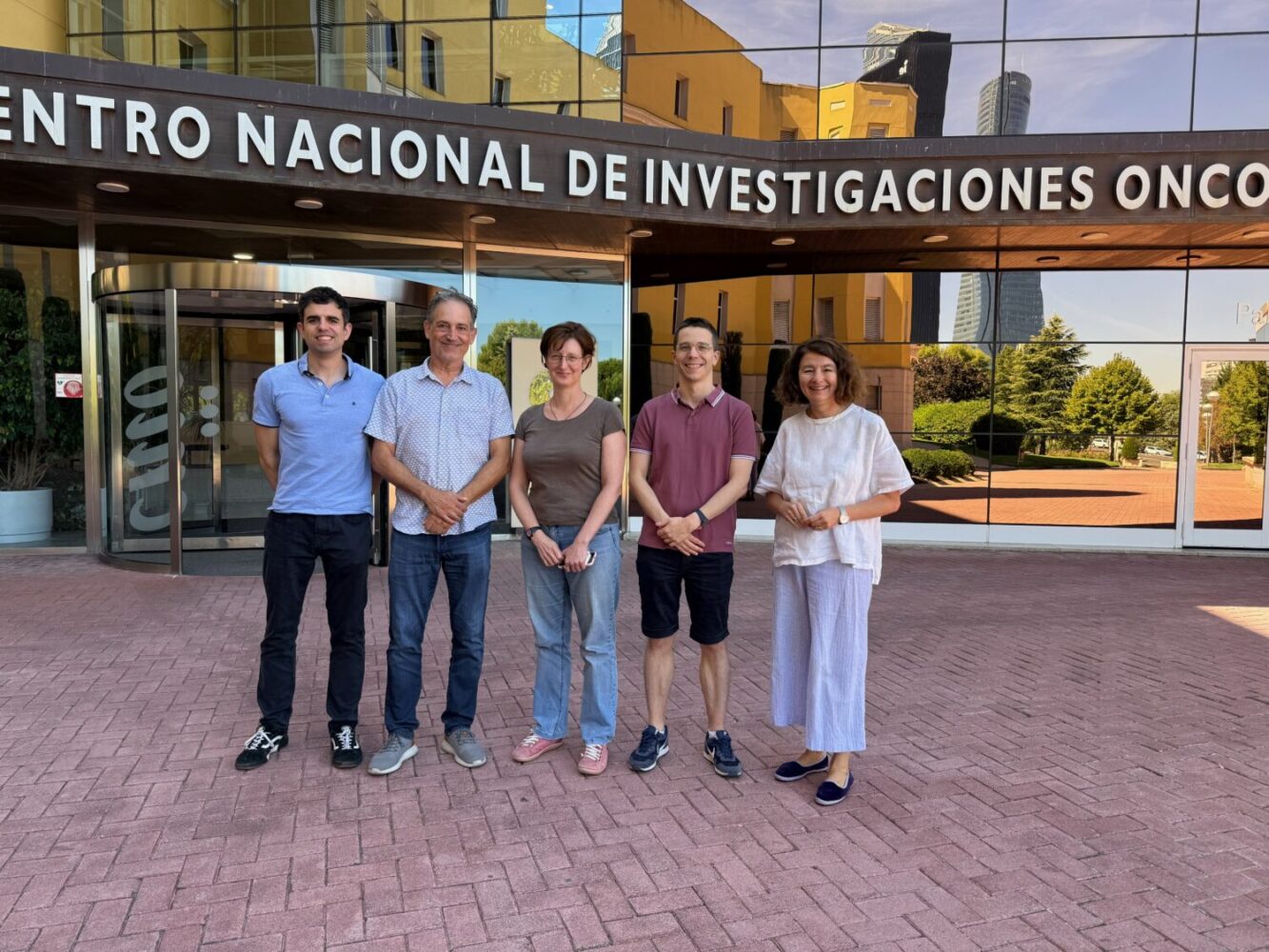
 From left to right: Roger Castells-Graells, Todd Yeates, Pablo San Segundo-Acosta, Johanne Le Coq and Jasminka Boskovic, co-authors of the published study.
Roger Castells-Graells’ team at the Spanish National Cancer Research Centre (CNIO) has engineered two new protein nanoparticles. Their potential applications, including in vaccines, have yet to be experimentally evaluated.
These structures self-assemble from identical building blocks, which could facilitate their production on an industrial scale.
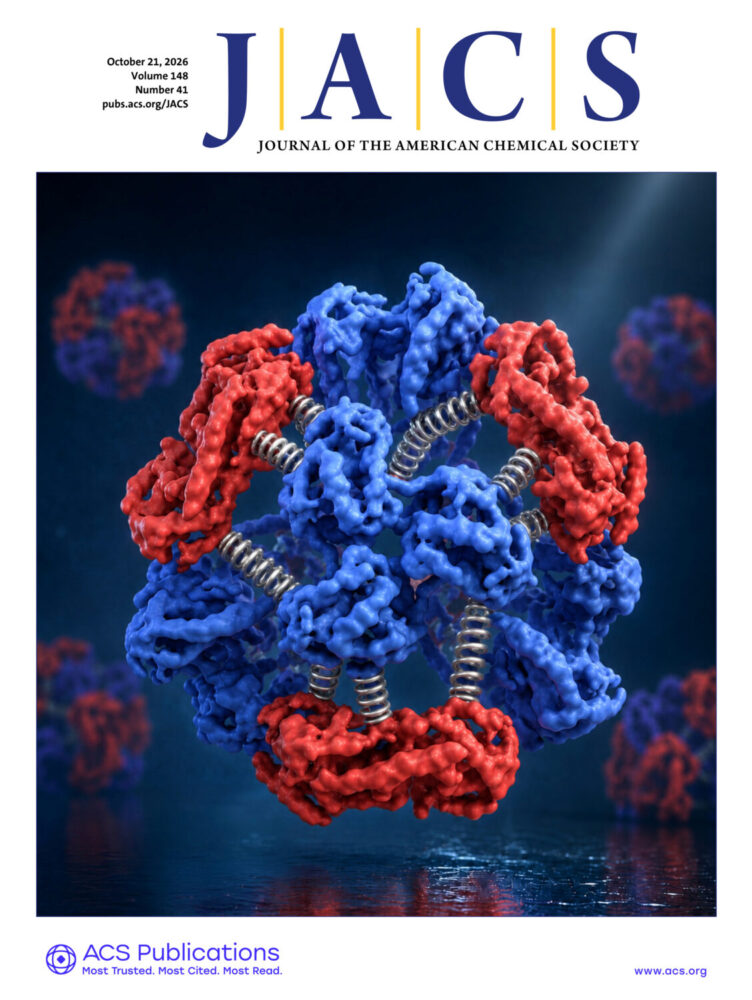
The study is featured on the cover of the Journal of the American Chemical Society (JACS).
A tiny cage made of proteins could be used to transport drugs through the body, or to carry molecules that alert our immune system to a threat. These are some of the potential applications that Roger Castells-Graells has in mind when designing protein nanoparticles and exploring how they might help treat cancer with his team at the Spanish National Cancer Research Centre (CNIO).
Two tiny hollow structures, the latest creations of Castells-Graells’ team at the CNIO, have earned a place on the cover of the Journal of the American Chemical Society (JACS).
The two nanoparticles measure just 15 nanometres in diameter. Around 5,000 of them would need to be lined up side by side to span the thickness of a human hair. What makes them particularly remarkable is the method used to produce them, which yields highly precise structures and could be more readily adapted to industrial-scale production than other approaches.
“They could be used both for drug delivery and as scaffolds for vaccines, for example,” explains Castells-Graells. In the latter case, the nanostructure would act as a support on which to display molecules that alert the immune system to threats, such as viruses or tumour cells. These antigens would thus be presented to the immune system, allowing it to recognise them and mount a defensive response.
However, such applications are still a long way off. The significance of the newly published study lies in demonstrating that protein nanoparticles can be designed and assembled with precision.
The study’s first author is CNIO researcher Pablo San Segundo-Acosta. Among its co-authors is Todd Yeates, a pioneer in the field and Castells-Graells’ mentor, who is a professor at the University of California, Los Angeles (UCLA) and a visiting researcher at the CNIO thanks to funding from Fundación Occident.
A microscopic, self-assembling Lego set
Building these nanoparticles is far from straightforward. As in a construction set, the individual pieces must be selected and the way they connect must be carefully planned. But this particular Lego set can only be seen under an electron microscope, and the pieces cannot be physically picked up and fitted together. In fact, these nanoparticles assemble themselves.
It is essential to understand how the building blocks fit together and how much their connections can bend, because even a slight deviation can distort the overall structure or prevent the cage from closing properly. The CNIO team used artificial intelligence to address this challenge. In the new nanoparticles, twelve paired building blocks come together to form a closed cage.
“These fusions are somewhat complicated because we need the beginning and end of each component to fit together perfectly,” says Castells-Graells. “We have achieved this fusion through a flexible helix, and then used artificial intelligence tools to make the assembly work while retaining that flexibility.”
A single building block for the entire cage
One of the innovations is that these protein nanoparticles are built from repeated copies of a single type of component, an advantage for their potential large-scale production.
“If we want to transfer this to the pharmaceutical or biotechnology industry, having many separate components can complicate production, because sometimes one is easier to produce than another,” the researcher explains.
To design the nanoparticles, the team selected proteins with known structures from the Protein Data Bank (PDB), an international repository of three-dimensional structures of biological molecules. They calculated how much the connections could bend based on the curvature observed in naturally occurring proteins.
They then used ProteinMPNN, a machine-learning tool, to select the amino acids, the molecular building blocks of proteins, that would help stabilise the connections.
Starting with fifteen designs, the researchers tested 45 variants in the laboratory. They produced the proteins in bacteria, purified them and selected three variants, corresponding to two distinct new nanoparticles, for detailed structural analysis.
High-resolution cryo-electron microscopy (cryo-EM) enabled the researchers to reconstruct their structures and examine how the building blocks were arranged in atomic detail. It also confirmed that the connections adopted a curvature close to the predicted values. This experimental validation supports the design method and makes it possible to identify where deviations occur.
Learning molecular design from viruses
Castells-Graells established his research group at the CNIO in 2025, after returning to Spain through the Construyendo la Generación IA programme, part of the Generación D initiative promoted by Red.es.
A Biotechnology graduate from the Universitat Autònoma de Barcelona, he completed his PhD at the John Innes Centre in the United Kingdom, where he studied the structural changes that enable a virus to mature. He subsequently joined Yeates’ laboratory at the University of California, Los Angeles (UCLA). There, he developed protein scaffolds that facilitate the structural characterisation of small proteins of therapeutic interest.
Reference article
Pablo San Segundo-Acosta, Johanne Le Coq, Jasminka Boskovic, Robin A. Aglietti, Peter Bowers, Todd O. Yeates, Roger Castells-Graells.
“Design and Structure of Protein Cages Based on Helical Fusion and Machine Learning.”
Journal of the American Chemical Society, 21 October 2026; 148 (41): 44372–44379.