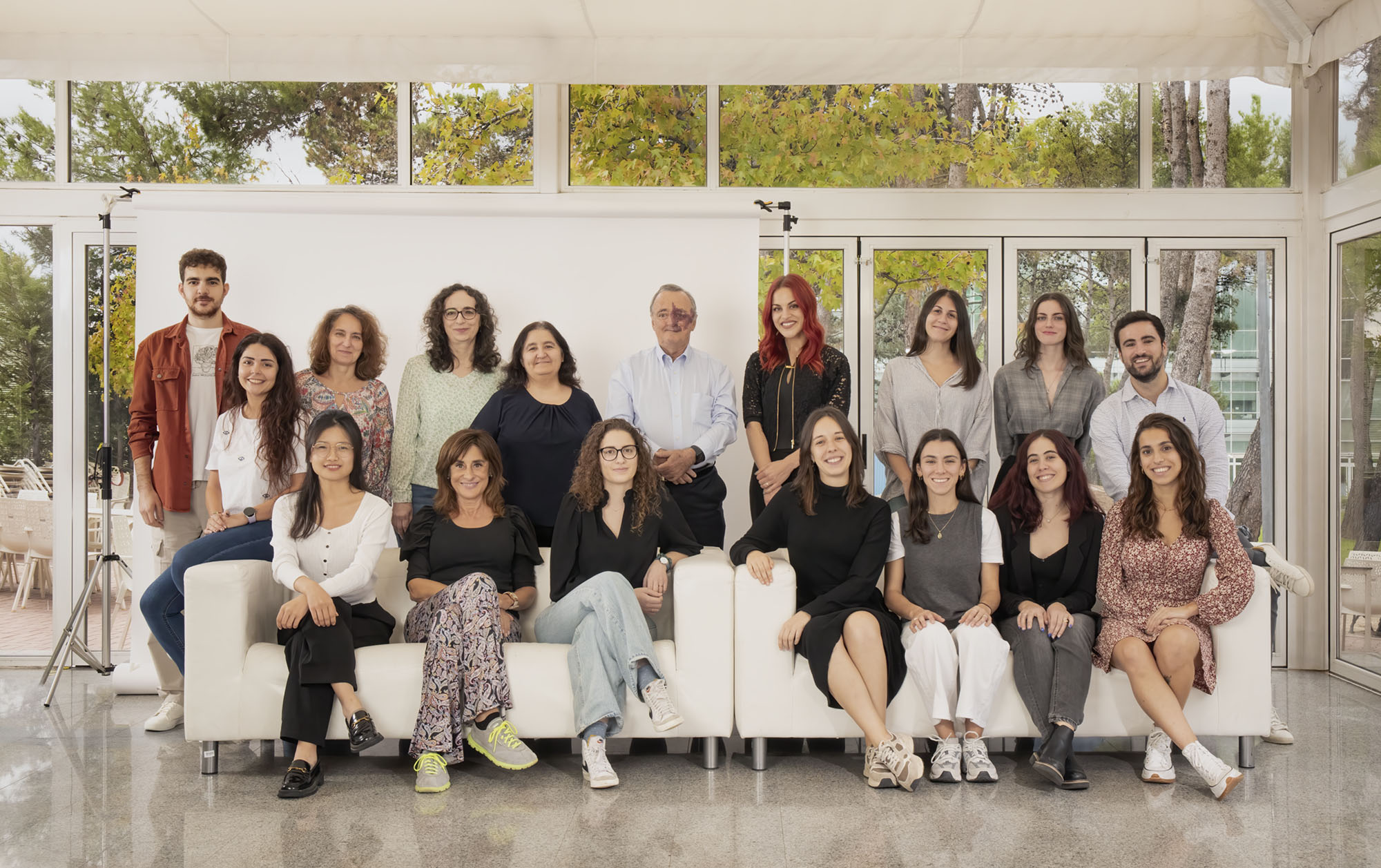
The main thrust of our laboratory is to identify therapeutic strategies against KRAS mutant lung and pancreatic tumours using genetically engineered mouse strains. We recently reported that ablation of KRAS oncogenes induces complete tumour regressions with no signs of tumour resistance. Unfortunately, KRAS inhibitors, either specific for selected mutations or panKRAS inhibitors, only result in partial tumour regressions. Moreover, this limited therapeutic activity is thwarted by the rapid appearance of tumour resistance. Five years ago, we reported that concomitant ablation of two targets involved in KRAS signalling, RAF1 and EGFR, led to the complete disappearance of a limited number of small pancreatic tumours. Yet, most tumours, especially those exhibiting sizes larger than 100 mm3, did not respond to this therapy. We have now identified a third target, STAT3, whose combined ablation with RAF1 and EGFR led to the complete disappearance of all pancreatic tumours regardless of size. More importantly, these mice remained tumour free for up a year. We are now trying to validate this therapeutic strategy using pharmacological approaches with the ultimate goal of translating these results to a clinical scenario.

Investigadores Científicos
- Sara García
- Carmen Guerra
Becarios Post-doctorales
- Juan Carlos López
Becarios Pre-Doctorales
- Domingo Acosta
- Gonzalo María Aizpurua
- Oksana Brehey
- Sara Barrambana
- Ana María Fernández
- Ana Galván
- Lucía Lomba
- Blanca Rosas
- Andrés Simón
- Pian Sun
- Elena Zamorano
Técnicos de Laboratorio
- Rebeca Barrero
- Mª Carmen González
- Silvia Jiménez
- Alejandra López
- Jorge Guillermo Ortiz
- Marta San Román
- Raquel Villar
Científico Visitante
- Matthias Drosten
- Mónica Andrea Musteanu
Publicaciones recientes
- (2026). A Phase III Randomized Trial of Integrated Genomics and Avatar Models for Personalized Treatment of Pancreatic Cancer: the AVATAR Trial.. Clin Cancer Res 31, 278-287. Publicación CNIO.
- (2025). Cell cycle duration determines oncogenic transformation capacity. Nature 641, 1309-1318. Publicación CNIO.
- (2025). Navigating the complexities of pancreatic ductal adenocarcinoma: A review on therapeutic models and RAS inhibitors. Adv Drug Deliver Rev 224, 115652. Publicación CNIO.
- (2025). The repressor Capicua is a barrier to lung tumor development driven by Kras/Trp53 mutations. EMBO Mol Med 17, 3377-3406. Publicación CNIO.
- (2025). Retracted article: A targeted combination therapy achieves effective pancreatic cancer regression and prevents tumor resistance. Proc Natl Acad Sci USA 122, e2523039122. Publicación CNIO.
- (2025). Different Ras isoforms regulate synaptic plasticity in opposite directions. EMBO J 44, 2103-2133. Publicación CNIO.
- (2025). Systemic Kras ablation disrupts myeloid cell homeostasis in adult mice. Proc Natl Acad Sci USA 122, e2512404122. Publicación CNIO.
- (2025). Interleukin-11 promotes lung adenocarcinoma tumourigenesis and immune evasion. Clin Transl Med 15, e70374. Publicación CNIO.
- (2025). Active R-RAS2/TC21 prevents cell cycle arrest and morphological alterations in mouse embryonic fibroblasts lacking RAS proteins. Oncogene 44, 1905-1921. Publicación CNIO.
 Open Access
 - (2025). Unlocking the Genetic Secrets of Pancreatic Cancer: KRAS Allelic Imbalances in Tumor Evolution. Cancers 17, 1226. Publicación CNIO.
- (2025). The rapidly growing landscape of RAS inhibitors: from selective allele blockade to broad inhibition strategies. Mol Oncol 19, 2991-2995. Publicación CNIO.
- (2025). T Cell-Specific Inactivation of the PI3K p110α Catalytic Subunit: Effect in T Cell Differentiation and Antigen-Specific Responses. INTERNATIONAL JOURNAL OF MOLECULAR SCIENCES 26, 595. Publicación CNIO.
- (2024). The Peptidoglycan Recognition Protein 1 confers immune evasive properties on pancreatic cancer stem cells. Gut 73, 1489-1508. Publicación CNIO. Open Access
- (2024). A Phase III Randomized Trial of Integrated Genomics and Avatar Models for Personalized Treatment of Pancreatic Cancer: the AVATAR Trial.. Clin Cancer Res (in press). Publicación CNIO.
- (2024). Type I interferon signaling pathway enhances immune-checkpoint inhibition in KRAS mutant lung tumors. Proc Natl Acad Sci USA 121, e2402913121. Publicación CNIO. Open Access
- (2024). CRISPR/Cas9 screenings unearth protein arginine methyltransferase 7 as a novel essential gene in prostate cancer metastasis. Cancer Lett 588, 216776. Publicación CNIO.
- (2024). Serum Amyloid A3 Fuels a Feed-Forward Inflammatory Response to the Bacterial Amyloid Curli in the Enteric Nervous System. Cell Mol Gastroenterol Hepatol 18, 89-104. Publicación CNIO. Open Access
- (2023). Rapid adaptation to CDK2 inhibition exposes intrinsic cell-cycle plasticity. Cell 186, 2623-2643. Publicación CNIO. Open Access
- (2023). Signature-driven repurposing of Midostaurin for combination with MEK1/2 and KRASG12C inhibitors in lung cancer. Nat Commun 14, 6332. Publicación CNIO.
- (2023). Kras oncogene ablation prevents resistance in advanced lung adenocarcinomas.. J Clin Invest 133, e164413. Publicación CNIO. Open Access
- (2023). Exploiting the intrinsic misfolding propensity of the KRAS oncoprotein. Proc Natl Acad Sci USA 120, e2214921120. Publicación CNIO. Open Access
- (2023). Establishment of Pancreatic Cancer-Derived Tumor Organoids and Fibroblasts From Fresh Tissue. J Vis Exp 195, e65229. Publicación CNIO.
- (2022). Structure of the RAF1-HSP90-CDC37 complex reveals the basis of RAF1 regulation. Mol Cell 82, 3438-3452. Publicación CNIO. Open Access
- (2022). Combined Inhibition of FOSL-1 and YAP Using siRNA-Lipoplexes Reduces the Growth of Pancreatic Tumor. Cancers 14, 3102. Publicación CNIO. Open Access
- (2022). KRAS inhibitors: Going non-covalent.. Mol Oncol 16, 3911-3915. Publicación CNIO. Open Access
- (2022). KSR induces RAS-independent MAPK pathway activation and modulates the efficacy of KRAS inhibitors. Mol Oncol 16, 3066-3081. Publicación CNIO. Open Access
- (2021). RAF1 kinase activity is dispensable for KRAS/p53 mutant lung tumor progression.. Cancer Cell 39, 294-296. Publicación CNIO. Open Access
- (2021). Dynamic Regulation of Expression of KRAS and Its Effectors Determines the Ability to Initiate Tumorigenesis in Pancreatic Acinar Cells. Cancer Res 81, 2679-2689. Publicación CNIO.
- (2021). KRAS4A induces metastatic lung adenocarcinomas in vivo in the absence of the KRAS4B isoform. Proc Natl Acad Sci USA 118, e2023112118. Publicación CNIO. Open Access
- (2021). Definitive evidence for Club cells as progenitors for mutant Kras/Trp53-deficient lung cancer. Int J Cancer 149, 1670-1682. Publicación CNIO. Open Access
- (2021). Targeting KRAS mutant lung cancer: light at the end of the tunnel.. Mol Oncol (in press). Publicación CNIO. Open Access
- (2021). ERK inhibitor LY3214996-based treatment strategies for RAS-driven lung cancer.. Mol Cancer Ther 20, 641-654. Publicación CNIO.
- (2021). RASless MEFs as a Tool to Study RAS-Dependent and RAS-Independent Functions. Methods Mol Biol 2262, 335-346. Publicación CNIO.